A fresher resume is a one-page resume for a candidate with no full-time work history. It leads with education, projects, internships, and skills instead of job titles. The right format helps recruiters and ATS software see your potential clearly, even without prior employment.
Key Takeaways
- A fresher resume leads with education and projects, not work experience.
- Section order matters more for freshers than for experienced professionals.
- Campus placements in India follow a specific hiring timeline and resume format, so it’s important to prepare your resume accordingly.
- A free, ATS-friendly PDF template beats a generic template hub for first-time resume writers.
If you’re staring at a blank page wondering what goes where, that’s a fair place to start. Most resume advice online is written for people who already have a job title to lead with. You don’t need one to write a resume that works.
Why Most Fresher Resume Advice Falls Short
A lot of the top-ranking guidance for “resumes for freshers” comes from general template libraries built for a global audience. They cover format basics well, but they rarely mention India-specific realities: campus placement drives, semester-based project timelines, or how Indian recruiters read a resume in a placement cell setting.
That’s a significant gap, not a small one. A fresher preparing for a campus placement drive in October needs different guidance than someone applying to international remote roles year-round. Most builder websites treat “fresher” as one global category ,it isn’t, and the timing, structure, and even the vocabulary shift depending on where you’re applying.
This guide is built with that context in mind, alongside a real worked example and template guidance you can use right away.
What a Fresher Resume Needs
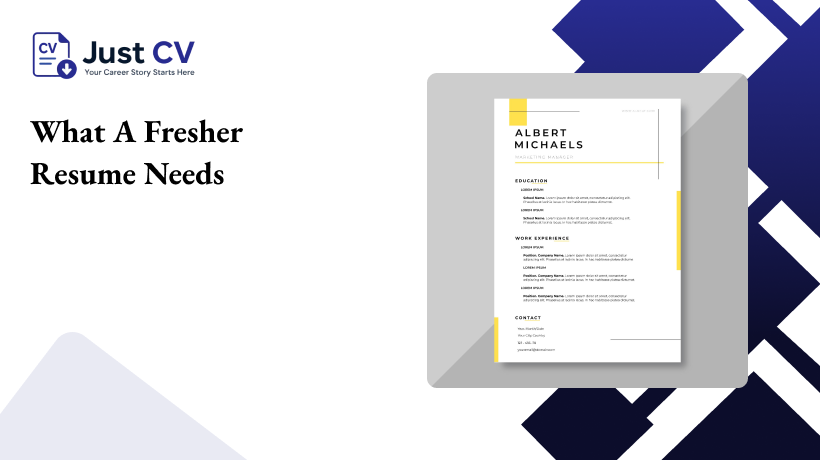
A fresher resume works differently from an experienced-professional resume. Since there’s no long job history to lead with, structure and clarity do the heavy lifting.
Checklist: What to include, in order
- Contact information -name, phone, email, city, LinkedIn (if you have one). Keep this in the main body, not a header, so ATS software reads it correctly.
- Professional summary or objective – 2–3 lines on what you’re looking for and what you bring. Keep it specific, not generic.
- Education – degree, institution, graduation year, relevant coursework or specialization. This section carries more weight for freshers than for experienced candidates.
- Projects – academic, personal, or hackathon projects. Describe what you built and what skills it demonstrates.
- Internships (if any) – treat even a short internship as real, relevant experience.
- Skills – technical skills, tools, and languages relevant to the role you want.
- Certifications (if any) – online courses, campus workshops, relevant credentials.
- Extracurriculars or leadership – college clubs, competitions, volunteering only if they show a relevant skill.
A quick note on experience: many freshers assume a resume without a job title isn’t strong enough to submit. Structured well, it is. Projects, internships, and coursework are real evidence of ability , a first job resume just presents that evidence differently, not less credibly, than a resume with years of employment behind it.
If you took on freelance work, contributed to an open-source project, or led a college fest committee while studying, that counts , it belongs in the same resume as your degree, not left off because it doesn’t look like a “real job.”
Fresher Resume vs. Experienced-Professional Resume
| Fresher Resume | Experienced Resume | |
|---|---|---|
| Leads with | Education, projects | Job titles, achievements |
| Section order | Education → Projects → Skills | Experience → Skills → Education |
| Length | 1 page | 1–2 pages |
| Proof of ability | Coursework, internships, projects | Quantified work outcomes |
| Common mistake | Leaving sections blank instead of reordering priority | Underselling recent achievements |
If you’re further along in your career, our Resume for Experienced Professionals: Format & Examples guide covers the format shift in detail.
A Full Worked Example
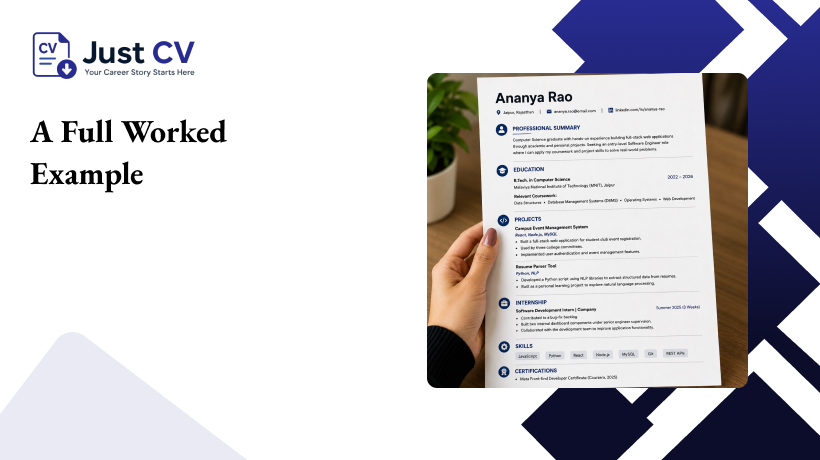
Below is a complete, realistic fresher resume example for a computer science graduate applying during a campus placement cycle. Use it as a structural reference – swap in your own education, projects, and skills.
Ananya Rao
Jaipur, Rajasthan | ananya.rao@email.com | linkedin.com/in/ananya-rao
Professional Summary
Computer Science graduate with hands-on experience building full-stack web applications through academic and personal projects. Seeking an entry-level software engineering role where I can apply my coursework and project skills to real product problems.
Education
B.Tech, Computer Science -Malaviya National Institute of Technology, Jaipur (2022–2026)
Relevant Coursework: Data Structures, Database Management Systems (DBMS), Operating Systems, Web Development.
Projects
Campus Event Management System – Built a full-stack web app (React, Node.js, MySQL) for student club event registration, used by 3 college committees.
Resume Parser Tool – Created a Python script using NLP libraries to extract structured data from resume PDFs, built as a personal learning project.
Internship
Software Development Intern, [Company] – 8 weeks, Summer 2025. Contributed to a bug-fix backlog and built two internal dashboard components under senior engineer supervision.
Skills
JavaScript, Python, React, Node.js, MySQL, Git, REST APIs
Certifications
Meta Front-End Developer Certificate (Coursera, 2025)
Notice what this example does: it treats the personal project and the short internship as equally worth describing in detail. Neither is padded with invented outcomes – each line describes what was actually built. That’s the standard to hold your own resume to as well: specific and real, not impressive-sounding and vague.
Free Templates for Freshers
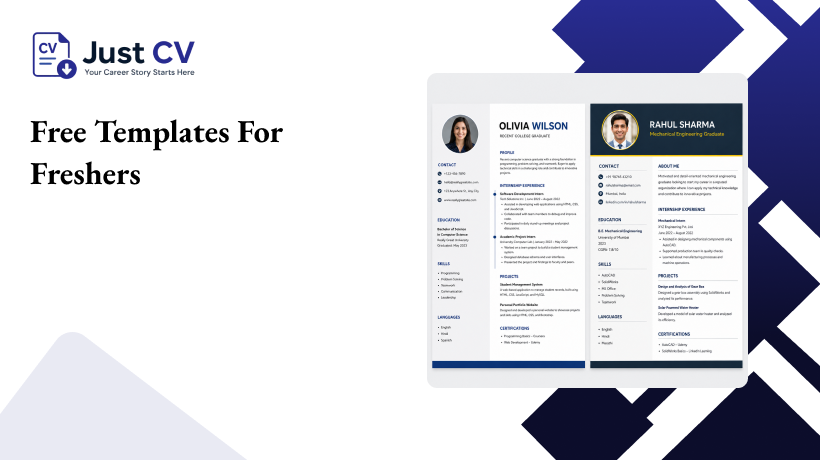
Once your content is in place, template choice matters for one main reason: ATS parsing. A visually striking template that an applicant tracking system can’t read correctly works against you before a recruiter even sees it.
What to look for in a fresher resume template:
- A single-column layout, so ATS software reads sections in the correct order.
- A real, selectable text layer in the exported PDF – not a flattened image.
- Clear section headings (Education, Projects, Skills) that match what recruiters and parsers expect.
- No graphics, icons, or tables layered over text content.
- A genuinely free export, including a free resume for freshers PDF – not a download that’s locked behind a paywall or limited to a plain-text file.
This is the exact point where a lot of fresher-resume advice online quietly stops being useful: it’s generic template-hub content, not guidance built for a first resume specifically. JustCV’s Resume Templates are built with a real text layer and single-column structure by default, and the free plan includes a genuine ATS-friendly PDF export – not a TXT-only download.
For a step-by-step build (rather than a template-first approach), our How to Write a Resume From Scratch guide walks through the same structure from a blank page.
Bringing It Together
A strong fresher resume isn’t a smaller version of an experienced resume – it’s a resume that leads with different, equally real evidence: education, projects, and initiative. Structured well, it gives a recruiter everything they need to shortlist you, campus placement season or otherwise.
If you want a head start on the format above, JustCV’s builder walks you through each section -education, projects, internships, and skills- one step at a time.
Build My Resume
FAQs
01. What should a fresher put on their first resume?
Lead with education, relevant coursework, academic or personal projects, and any internships. Add a skills section and certifications if you have them. Work history isn’t required- projects and coursework serve as your proof of ability instead.
02. Do freshers need work experience on a resume?
No. A fresher resume is built around education, projects, and internships instead of work history. Recruiters reviewing entry-level roles expect this structure and don’t penalize its absence.
03. How long should a fresher resume be?
One page. At this stage, you likely don’t have enough content to justify a second page, and a focused one-page resume is easier for both recruiters and ATS software to scan.
04. Should freshers include a career objective or a summary?
A short 2–3 line summary works better than a generic objective. State the role you’re targeting and one or two specific strengths, rather than a broad statement about wanting to “grow professionally.”
05. What format works best for ATS during campus placements?
A single-column layout with clear section headings and a real text layer in the exported PDF. Avoid tables, graphics, or a two-column design, since some ATS parsers misread the reading order.
06. Can personal projects replace work experience on a fresher resume?
Yes. Academic, personal, and hackathon projects are legitimate evidence of skill, especially when described with specifics – what you built and what it demonstrates, not just a project title.
07. Is a resume template enough, or does content matter more?
Content matters more. A well-structured template supports a clear resume, but the education, project, and skills content is what recruiters and ATS systems actually evaluate.