A CV is a detailed, longer document mainly used for academic, research, or international roles. A resume is a shorter, focused summary of your skills and experience, commonly used for job applications in the US, Canada, and India. The two aren’t interchangeable, and picking the wrong one can cost you an interview before a recruiter even reads your experience.
If you’ve searched for a “cv builder” and landed on a tool that calls itself both a CV builder and a resume builder, sometimes on the same page, you’re not imagining the confusion. Most resume tools treat the two terms as interchangeable for marketing purposes. That’s fine until you’re actually applying somewhere that expects one specific format, and you submit the wrong one.
This guide clears up the difference in plain language, helps you figure out which document you actually need, and explains exactly what JustCV’s builder supports today: no overselling, no vague claims.
CV vs. Resume: What’s Actually Different
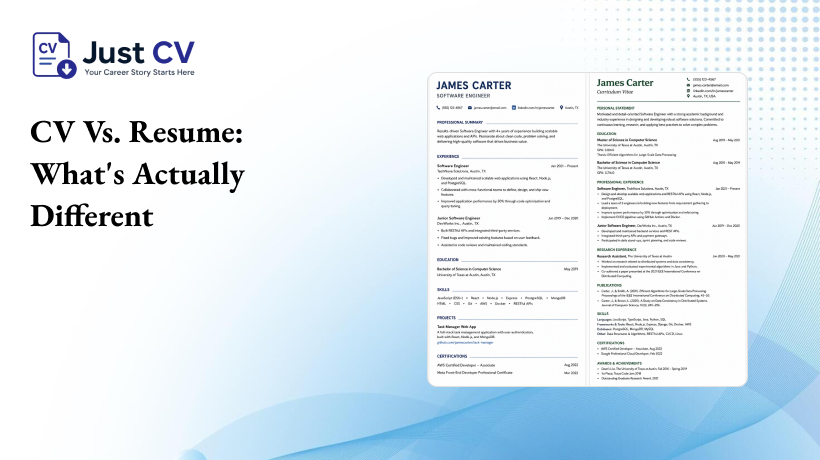
The short version: length, purpose, and geography.
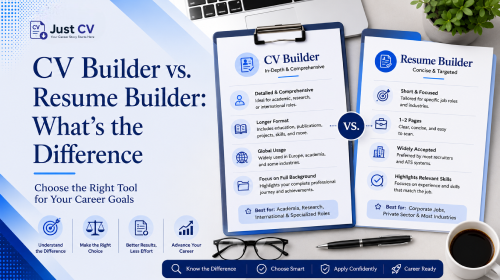
A resume is usually one or two pages long. It’s a focused snapshot of your most relevant experience, built for a specific job. It’s the standard format used across most private-sector jobs in the United States, Canada, and India.
A CV is longer, often multiple pages, and grows over time to cover your full academic and professional history: publications, research, teaching experience, conferences, and credentials. It’s the standard format for academic, medical, scientific, and research roles, and it’s also what many employers in the UK, most of Europe, and Australia call the document you’d otherwise call a “resume” in the US.
Here’s the distinction laid out directly:
| Resume | CV | |
|---|---|---|
| Typical length | 1 to 2 pages | 2+ pages, grows over time |
| Primary use case | Private-sector job applications | Academic, research, medical, and international roles |
| Common in | United States, Canada, India (private sector) | UK, most of Europe, Australia (as the standard job-application document); academia everywhere |
| Content focus | Relevant experience, tailored per job | Full career and academic history |
| Updates per application | Tailored for each application | Usually one master document that evolves over time |
This is the key difference that most resume builder sites often miss For example, FlowCV ranks well for both “CV builder” and “free CV maker,” but it often uses the two terms interchangeably without clearly explaining when to use a CV versus a resume. If you’re applying to a UK role expecting a “CV” and a US-style two-page resume format, or applying to a US company with an academic-style multi-page CV, that mismatch is worth understanding before you build anything.
Which One Do You Need
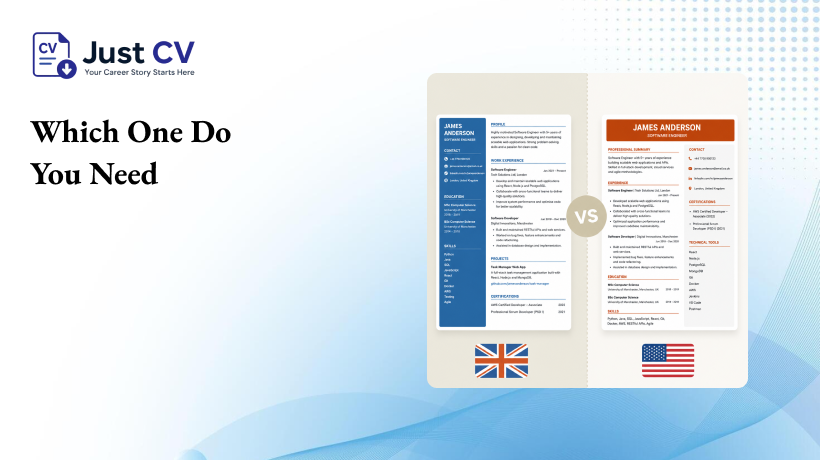
Use this quick checklist to decide which document is right for you:
- Applying to a private-sector job in the US, Canada, or India? You need a resume: concise, tailored, and usually one to two pages long.
- Applying for a job in UK, most of Europe, or Australia? The employer may call it a “CV,” but it works more like a US-style resume: short, focused, and tailored to the role rather than a detailed academic CV.
- Applying for an academic, research, teaching, or fellowship position anywhere? You need a full academic CV: comprehensive, with publications and credentials, regardless of country.
- Applying for a medical, scientific, or research-heavy role? A CV is standard, even in the US.
- Not sure which the employer means? Check the job posting’s wording and length expectations first. “CV” in a UK private-sector posting usually means a resume-length document, not an academic CV.
Changing careers or moving between industries? Choose your document type based on the target role’s expectations, not your current role. Always check the job posting to be sure.
If you’re an international applicant, say, applying to jobs in the UK, US, and India during the same search, you may genuinely need both a resume-style document and a full academic CV, depending on which roles you’re targeting. That’s a real, common situation, and it’s not a sign you’re doing something wrong. It just means the format follows the role, not the other way around.
How JustCV’s Builder Works
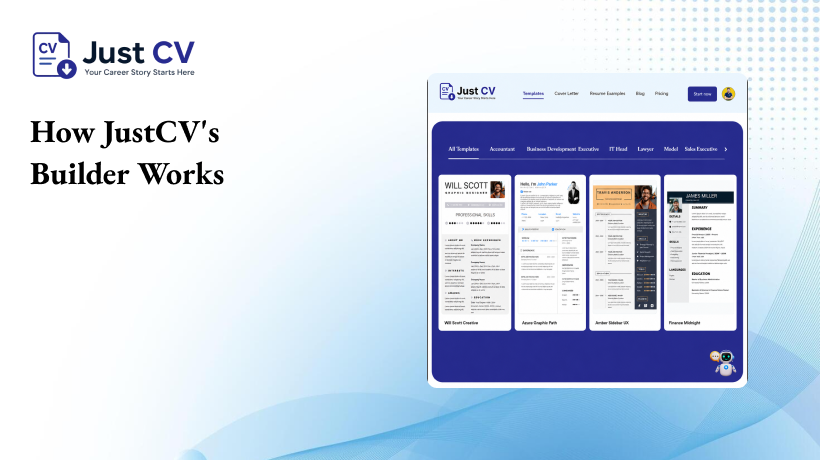
Here’s exactly what JustCV supports today, stated plainly: JustCV’s builder is built for resume-style documents, with ATS-friendly templates, AI-assisted bullet point suggestions, and free PDF and DOCX export. This covers the standard resume format used across the US, Canada, India, and most private-sector roles in the UK, Europe, and Australia.
A dedicated academic or international CV template (multi-page, publications-and-credentials format) is on JustCV’s roadmap and not yet live. If you need a full academic CV specifically, today’s builder isn’t the right tool for that document type yet; we’d rather tell you that directly than have you build something that doesn’t fit what you need. This page will be updated once that template ships.
What JustCV gives you for free, without locking you into a trial:
- A truly free plan should include a real, downloadable ATS-friendly PDF, not just a preview hidden behind a paid upgrade.
- AI that drafts and suggests bullet points based on what you tell it; you stay in control of every line.
- A Resume Score so you can see how your document is shaping up before you send it.
- No card required to start, and no countdown timer pushing you to decide faster than you want to.
If you’re a Career Changer moving into a new industry, or applying somewhere your last job title doesn’t quite explain, that experience still belongs on the page. Career changes and industry shifts aren’t a gap to explain away. That counts, and it’s exactly the kind of experience JustCV’s AI suggestions are built to help you frame clearly.
Getting Started
Once you know which document your target role requires, the next step is simple:
- Confirm the format the employer expects (resume-style vs. academic CV) from the job posting.
- If it’s a resume-style document, start building with a template suited to your industry.
- Let JustCV’s AI suggest a first draft of your bullet points; you edit and approve each line.
- Check your Resume Score before exporting.
- Download your free ATS-friendly PDF or DOCX. No card, no waiting.
Frequently Asked Questions
See the FAQ section below for direct answers to the most common CV-vs-resume questions.
Choosing the right document format is half the battle; the other half is actually building one that represents your experience well. If you’re ready to start, JustCV’s AI can suggest a first draft based on what you tell it, and you can see exactly how it looks before you commit to anything.
See Suggestions →
FAQs
Q1: What is the main difference between a CV and a resume?
A CV is a longer, comprehensive document covering your full academic and professional history, while a resume is a short, targeted summary (usually one to two pages) built for a specific job. The right one depends on your industry and target country.
Q2: Is a CV the same as a resume in the UK?
In the UK, “CV” is the standard term for the document Americans call a resume: short and tailored per application. It’s different from the longer academic CV used for research or teaching roles, which follows the same multi-page format everywhere.
Q3: Do I need a CV or a resume for a job in the US?
For most private-sector jobs in the US, you need a resume: one to two pages, tailored to the role. A full academic CV is only expected for academic, research, or medical/scientific positions.
Q4: Can I use the same document as both a CV and a resume?
Not usually. A resume is intentionally short and tailored per job, while a CV is a comprehensive, evolving record. Trying to use one for both purposes often means it’s either too short for a CV’s purpose or too long for a resume’s.
Q5: Does JustCV offer a CV builder or a resume builder?
JustCV’s builder currently supports resume-style documents, with ATS-friendly templates and free PDF and DOCX export. A dedicated academic or international CV format is on the roadmap and not yet live; we’ll update this page once it ships.
Q6: Is there a free CV maker that doesn’t require a credit card?
Yes. JustCV’s free plan gives you a genuine, downloadable ATS-friendly PDF with no card required to start. For resume-style CV/resume documents, the format used across most private-sector applications, it’s free to build and export.
Q7: How do I know if a job posting wants a CV or a resume?
Check the posting’s wording and expected length. A UK, European, or Australian posting using “CV” for a standard private-sector role usually means a resume-length document, not the longer academic CV format.
Q8: What format should international applicants use?
It depends on the target country and role type. If you’re applying across multiple countries or industries, check each posting individually; the expected format follows the role, not your home country’s convention.