A resume for experienced professionals should lead with measurable results, not job duties. Once you have 5+ years of experience, your resume needs to show the impact you’ve had not just where you worked. This guide covers what changes, how to format it, and a full worked example you can build from.
Key Takeaways
- Lead with results, not duties quantify the impact, not just the task.
- Condense early roles into one line each once you’ve built a real work history.
- Choose your format based on career path, not habit (see the format table below).
- A recruiter’s first scan is short. Structure your resume so the strongest line is easy to find fast.
What Changes After 5+ Years
A fresher’s resume has to prove potential. An experienced professional’s resume has to prove impact. That’s the core shift, and it changes almost every line you write.
Here’s what’s structurally different once you’ve built a real work history:
- Results replace responsibilities. ” Managed a team of six” describes a responsibility. ” Led a team of six to reduce onboarding time by one-third” highlights a measurable impact. Recruiters scanning experienced-candidate resumes are looking for the second kind of sentence.
- Early roles get condensed. Your first job out of college doesn’t need the same four bullet points it once did. One line, or a short “Additional Experience” block, is usually enough once you have 5+ years behind it.
- Your summary shifts tone. A fresher’s summary describes what they hope to bring. An experienced professional’s summary states what they’ve already delivered.
- Skills get specific. “Strong communication skills” gives a recruiter nothing to verify. “Presented quarterly results to leadership” does.
- Length can grow carefully. A one-page resume is still the standard for most mid-career professionals. Two pages becomes reasonable once your achievements genuinely need the room, not as a default.
This structure matters because recruiters make their first impression in just a few seconds. TheLadders’ widely-cited 2018 eye-tracking study found recruiters spent an average of 7.4 seconds on an initial resume screen (source: theladders.com, Eye-Tracking Study PDF). That figure is several years old, and some recruiters have since questioned the methodology. Treat it as a general guideline rather than an exact benchmark but the core takeaway remains valid: your strongest, most quantified line needs to be easy to find fast, not buried in paragraph four.
None of this means your early experience stops counting. A first internship, a lateral move, or a stretch role you took on early in your career that counts, and it’s fine to keep a condensed line for it. The goal isn’t to erase your earlier experience. It’s to make the most relevant achievements stand out first. It’s to stop letting them take up the space your recent results have earned.
Where competitors fall short: Most resume-for-experienced-professionals content online is written to apply to everyone from year 5 to year 25. That’s too wide a band to be genuinely useful. A 6-year professional and a 20-year VP need different guidance the first is still building a case for growth, the second is managing a leadership narrative. This guide is scoped specifically to the 5–15 year “experienced but not yet executive” range, so the advice actually fits.
Choosing the Right Format

Format choice for an experienced-professional resume follows the same core rules as any other resume – this section won’t re-explain reverse-chronological vs. functional formatting in full. For a complete walkthrough, see our Resume for Freshers: Format, Examples & Free Templates guide, which covers the format fundamentals in depth.
The short version for this stage of your career and once you’ve picked a format, you can browse resume templates built for each style below.
| Format | Best fit for experienced professionals | Watch out for |
| Reverse-chronological | Most experienced professionals with a consistent career progression. | Less effective if you need to explain a career gap or major career change. |
| Combination (skills + chronological) | Professionals pivoting industries while keeping 5+ years of relevant experience visible | Needs a strong skills section up top to earn its place |
| Functional | Rare at this stage — usually a signal to a recruiter that something is being minimized | Can raise more questions than it answers past entry-level |
Quick reference : what recruiters expect to see, in order:
- Name and contact details
- A short professional summary (2–3 sentences, results-led)
- Core skills, specific and scannable
- Work experience, most recent first, with quantified bullet points
- Education (brief this isn’t the focus at this stage)
- Optional: certifications, relevant projects
A Worked Example
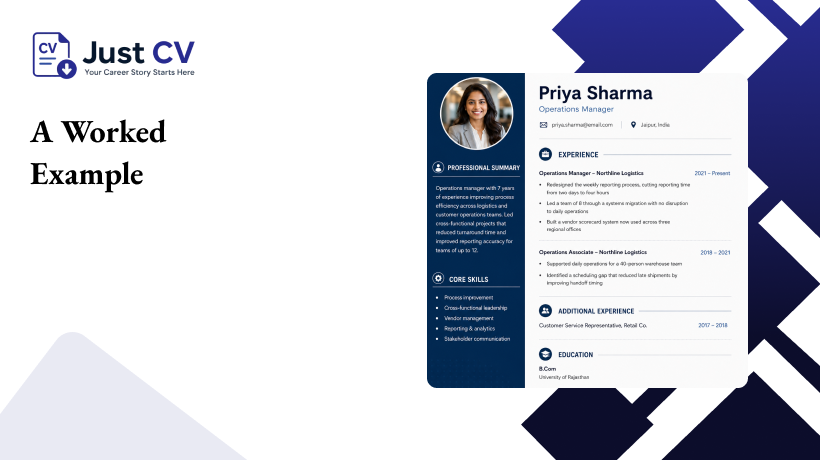
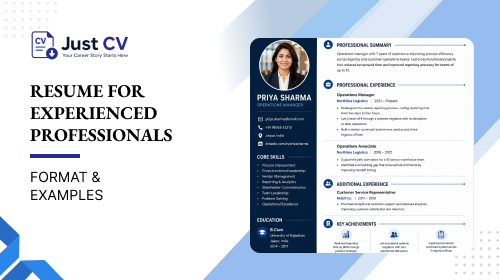
The following is a worked example built to demonstrate structure and phrasing -it’s illustrative, not a real customer resume.
Priya Sharma
Operations Manager · priya.sharma@email.com · Jaipur, India
Professional Summary
Operations manager with 7 years of experience improving process efficiency across logistics and customer operations teams. Led cross-functional projects that reduced turnaround time and improved reporting accuracy for teams of up to 12.
Core Skills
Process improvement · Cross-functional leadership · Vendor management · Reporting & analytics · Stakeholder communication
Experience
Operations Manager -Northline Logistics (2021–Present)
- Redesigned the weekly reporting process, cutting reporting time from two days to four hours
- Led a team of 8 through a systems migration with no disruption to daily operations
- Built a vendor scorecard system now used across three regional offices
Operations Associate -Northline Logistics (2018–2021)
- Supported daily operations for a 40-person warehouse team
- Identified a scheduling gap that reduced late shipments by improving handoff timing
Additional Experience
Customer Service Representative, Retail Co. (2017–2018)
Education
B.Com, University of Rajasthan
Notice what this example does: the most recent role gets the most detail and the strongest verbs. The earliest role is a single line. Every bullet in the top two roles states an outcome, not just a task. Use this as your model- the numbers, job titles, and achievements should reflect your own experience and career. AI Suggestions can help you draft that first version without starting from a blank page.
If you’re in a technical role, the same principles apply with field-specific phrasing – see IT & Software Resume Examples That Get Shortlisted for bullet-point examples suited to that field.
Bringing It Together
A resume for experienced professionals earns its interviews by showing results, not by listing responsibilities. Get the format right, condense the early roles, and let your last 5+ years of experience carry the weight it deserves.
Ready to put your own experience into a resume that shows what you’ve actually built? Improve My Resume with JustCV – AI-assisted drafting, ATS-friendly templates, and a Resume Score to check your work, with no card required to start.
FAQs
How is a resume different for an experienced professional vs. a fresher?
An experienced professional’s resume leads with measurable results and outcomes, while a fresher’s resume leads with education, potential, and transferable skills. The shift happens because you now have a track record to point to instead of just promise.
Should I list every job I’ve had?
No. Once you have 5+ years of experience, condense your earliest roles into a single line or a short “Additional Experience” section. Keep the detail for the roles most relevant to the job you want next.
How long should a resume be after 5+ years of experience?
One page is still standard through the mid-career stage. Two pages becomes reasonable only once your achievements genuinely require the space not as a default choice.
What if I’m changing industries after several years of experience?
A combination format, leading with a strong skills section, can help transferable experience stand out. Your prior experience still counts the framing just needs to connect it to the role you’re targeting.
Do I still need a professional summary if I have years of experience?
Yes, but it should state what you’ve delivered, not what you hope to bring. Two to three sentences focused on results is usually enough.
What’s the difference between a resume for experienced professionals and an executive resume?
An experienced-professional resume (roughly 5–15 years) still builds a growth case showing increasing responsibility and results. An executive resume shifts toward leadership narrative, strategic impact, and organization-wide outcomes.
How many bullet points should each job have?
Two to four bullet points for your most recent, most relevant roles is typical. Older or less relevant roles can shrink to one line.