If you took time away from work, list it as its own entry with a title, dates, and one or two lines on what you did. A resume after a career break doesn’t need a confession or an apology. It needs the same clear structure as any other role, so a recruiter can read it in seconds and move on to your qualifications.
Maybe you stepped away for family caregiving. Maybe it was health, relocation, or finishing a degree. Whatever the reason, the question you’re probably asking is simple: how do I put this on paper without it working against me? Below is a practical, no-drama way to answer that.
Why Career Gaps Get Flagged (and Why That’s a Filter Problem, Not Yours)

Most applicant tracking systems and resume screens were built around one assumption: a career is a straight, unbroken line. Resumes with a career break, a return to work, or a career change don’t always follow the standard pattern, so they may receive a closer review.
That’s a limitation of the filter, not a judgment on you. Caregiving, recovery, relocation, and further study are all common, well-understood reasons people step away from paid work. The screening logic just hasn’t caught up to how people actually build careers today.
This matters for how you write your resume after a career break. You’re not writing to excuse a gap you’re writing to give a screening system, and eventually a human, an entry it can actually parse. A blank space with no label reads as unclear. A labeled, dated entry reads as information.
You’re also in more company than it might feel like. A 2025 Career Gaps Report from MyPerfectResume found that nearly half of U.S. workers 47% have taken a career break at some point, even as roughly 30% of employers said they still view those gaps unfavorably. That gap between how common breaks are and how they’re sometimes perceived is exactly why a clear, labeled entry matters: it closes the distance between the two.
One quick note on employment gap language: you’ll see plenty of guides refer to this as an “employment gap” that needs explaining. Around here, we’d rather call it what it is time away and treat it as part of your career story, not a problem to solve.
How to Show a Career Break on Your Resume
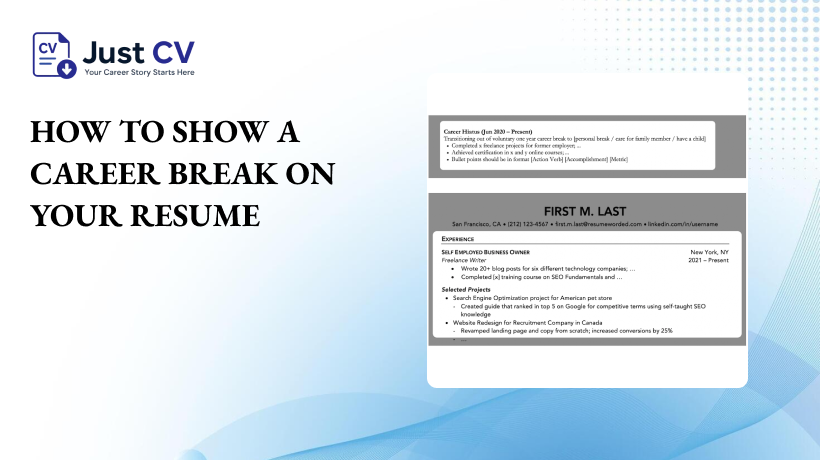
Here’s the short version, as a checklist you can apply directly:
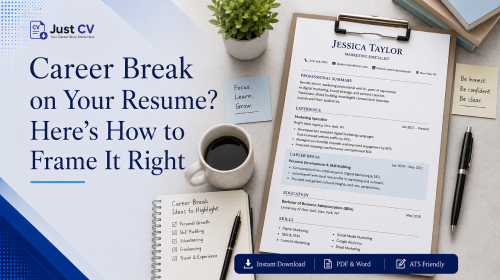
- Give it a real title. Use a plain, specific label-“Family Caregiving Leave,” “Health Recovery Leave,” “Independent Study” , instead of leaving a blank line in your work history.
- Add exact dates. Month and year, same format as every other entry on the page. Consistency matters more than the length of the gap.
- If you have something meaningful to include, add one or two brief lines. Coursework, caregiving responsibilities, volunteer work, or certifications all count as valuable experience.
- Place it in chronological order, exactly where it falls in your timeline don’t hide it at the bottom or leave it off entirely.
- Keep the tone factual, not apologetic. State what happened; skip the justification.
- If you did anything skill-adjacent during the break- freelancing, an online course, volunteering pull the specifics into your skills or experience section too, not just the gap entry.
A career gap resume built this way reads as complete, not defensive. If you also made a career change during or after your break, the same structure works just label the entry to reflect what you were actually doing, whether that’s a course, a project, or a transition period. For that scenario specifically, “Resume for a Career Transition: How to Make Your Experience Count” (internal link) walks through how to frame transferable skills alongside a break.
If your break was specifically parental leave, “Resume After Maternity Leave: A Complete Return-to-Work Guide” (internal link) covers that situation in more depth, including timing your return and reframing caregiving as real experience.
Comparison: How This Approach Differs From What’s Already Out There
| Source | What it offers | What’s missing |
|---|---|---|
| Indeed’s employment gap guide | Thorough, practical steps for explaining a gap on a resume and in interviews | Generic across industries; frames the gap as something to justify rather than a normal entry; no validating language |
| Press coverage of gap-related survey data | Confirms this is a topic real publications and employers are actively discussing | A press writeup, not a step-by-step guide – nothing a reader can apply directly to their own resume |
| This guide | A concrete, labeled-entry framework plus a worked example and a sourced 2025 data point on how common career breaks are | Still growing -no JustCV-published outcome data yet |
Career break resume guidance elsewhere tends to fall into two camps: press coverage that proves the topic matters, or generic advice that treats a gap as a flaw to smooth over. Neither gives you a template you can copy the structure from. That’s the gap this piece is built to close.
Worked Example
Here’s how this approach works in practice.
Before – the blank-space approach:
Marketing Coordinator|Bright Path Co. 2019–2022
[unlisted gap]
Marketing Manager |Fielding & Co 2024–Present
After – the labeled entry approach:
Marketing Coordinator|Bright Path Co. 2019–2022
Career Break – Family Caregiving 2023–2024
Managed full-time caregiving for a family member;
completed a project management certification during this period.
Marketing Manager |Fielding & Co 2024–Present
The second version gives a screening system, and a recruiter, an actual entry to read – not a gap to wonder about. It’s the same amount of honesty, presented as information instead of an omission.
If you took on any freelance work, volunteering, or coursework during your time away, that’s real, resume-worthy experience. That counts and it deserves its own line, not a footnote.
Putting It Together
A resume after a career break works the same way any strong resume works: clear structure, honest content, and no wasted space. The gap doesn’t need a cover story. It needs a label, a date range, and where there’s something to include a line or two of what happened.
JustCV’s Career Break module, in development as part of our Career Growth tools, is being built around exactly this approach: a dedicated way to add time away to your resume without treating it as something to hide. Until it’s live, you can apply this framework directly inside any of JustCV’s “ATS-friendly templates” (internal link) the structure works the same whether you’re using the module or building the entry by hand.
Ready to build a resume that includes your whole story? Start Free that counts, and it’s about to show on your resume.
FAQs
Will a recruiter just see the gap and stop reading?
Not if it’s labeled clearly. A dated, titled entry like “Family Caregiving Leave, 2023–2024” reads as information, not a red flag. Recruiters are used to seeing career breaks; what stands out is a resume that skips the entry entirely, leaving the timeline unclear.
How do I list a career break on my resume?
Add it as its own entry in your work history, in chronological order. Give it a title (e.g., “Health Recovery Leave”), include start and end dates, and add one or two lines if there’s relevant activity to mention.
Do I need to explain why I took the career break?
No. A short, factual label is enough. You’re not required to justify the reason caregiving, health, relocation, or study are all common and don’t need further explanation on the page.
What if I did nothing “resume-worthy” during my break?
List it anyway, with a title and dates. An honest, labeled entry is still clearer than a blank space in your timeline and it keeps your work history accurate.
Is a career break the same as an employment gap?
They describe the same thing. This guide prefers “career break” because it doesn’t frame the time away as a deficiency but either term is fine to use in your own resume if it fits your field’s conventions.
Should I mention a career break in my cover letter too?
Only if you want to add context beyond what’s on your resume. The resume entry alone is usually sufficient; a cover letter mention is optional, not required.
Does a career break hurt my chances during a career transition?
Not inherently. If you’re also changing industries or roles, focus your resume on transferable skills and any relevant activity from your time away the break itself doesn’t need separate justification from the transition.