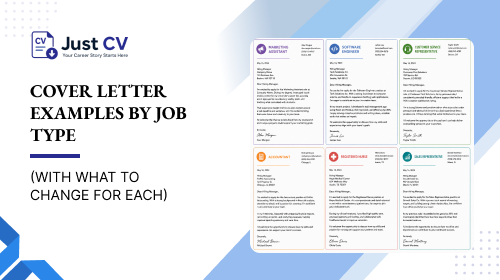
A strong cover letter example shows you what to change for your own situation, not just which job title to swap in. Below are four annotated examples: entry-level, career change, technical, and career break, each with notes on what makes it fit, so you adapt instead of copy.
Last updated: August 2026
Key Takeaways
- A cover letter example is only useful if it tells you what to adapt, not just what to copy.
- The same paragraph structure rarely works for an entry-level application and a career-change application; the emphasis has to shift.
- Research from Jobscan found that candidates who submit a cover letter are roughly 1.9 times more likely to be invited to interview, based on its analysis of real applications, one reason it’s worth the extra ten minutes.
- Short cover letters (150 to 250 words) tend to outperform long ones for most roles, especially when applying online.
Why Most Cover Letter Roundups Fall Short
Search “cover letter examples” and you’ll find long lists that swap the job title but keep the same underlying paragraph structure underneath. That’s useful for formatting, but it doesn’t tell you what actually needs to change when your situation is different. A fresh graduate, a career changer, and a technical specialist are not making the same argument to a hiring manager.
This guide takes a different approach: fewer examples, each annotated with the specific adjustments that make it work for that context. If you’re looking for the format and structure of a cover letter itself, margins, greeting, sign-off, see the Cover Letter Format guide instead; this post focuses on content differences by situation.
4 Examples by Job Type
1. Entry-Level / First Job Cover Letter Example
Best for: recent graduates, interns, first-time applicants with limited paid work experience.
Dear Hiring Manager,
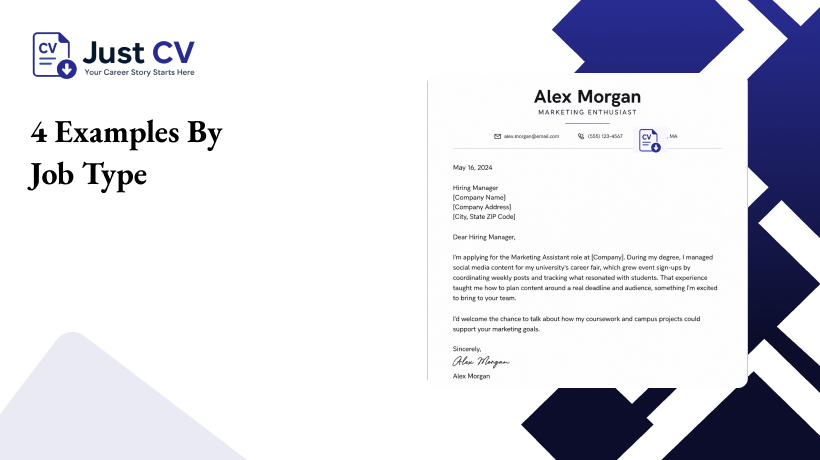
I’m applying for the Marketing Assistant role at [Company]. During my degree, I managed social media content for my university’s career fair, which grew event sign-ups by coordinating weekly posts and tracking what resonated with students. That experience taught me how to plan content around a real deadline and audience, something I’m excited to bring to your team.
I’d welcome the chance to talk about how my coursework and campus projects could support your marketing goals.
[Name]
What to adapt: Replace the coursework or project example with your own: a class project, internship, volunteer role, or student organization. The goal is one concrete example of you doing something similar to the actual job, not a list of skills. Keep it to one story, told with specifics (what you did, what happened), rather than three vague ones.
2. Career Change Cover Letter Example
Best for: switching industries or roles, for example, teaching to corporate training, or retail management to HR.
Dear [Hiring Manager],
I’m writing to apply for the HR Coordinator position at [Company]. For the past four years, I’ve managed classroom scheduling, conflict resolution, and one-on-one coaching as a high school teacher. Those skills map directly onto the day-to-day of HR coordination, even though the setting is different.
I’m not new to managing people and process; I’m applying that experience to a new industry, and I’d like to show you how.
[Name]
What to adapt: Name the transferable skill explicitly and connect it to the new role in the same sentence; don’t make the hiring manager do that translation themselves. Choose one or two transferable skills, not five, and make the connection concrete rather than assumed.
3. Technical Role Cover Letter Example
Best for: software, engineering, data, and other roles where the resume already carries technical proof.
Dear [Hiring Manager],
I’m applying for the Backend Developer role at [Company]. I built and shipped a caching layer that reduced API response times on a project handling roughly 10,000 daily requests. That’s the kind of performance problem your job posting mentions your team is currently solving.
My resume covers the full technical background; I wanted this note to focus on why your specific problem is one I’ve already worked on.
[Name]
What to adapt: Keep this one shorter than the others; technical hiring managers often weight the resume and portfolio more heavily. Use the letter to connect one specific, verifiable project to one specific problem mentioned in the job posting, rather than repeating your skills list.
4. Career Break / Returning to Work Cover Letter Example
Best for: returning after parental leave, caregiving, relocation, or health recovery.
Dear [Hiring Manager],
I’m applying for the Project Coordinator role at [Company]. Before taking two years away from full-time work for family caregiving, I managed cross-team timelines and vendor coordination for a mid-sized events company, and during that time away, I stayed current by completing a project management certification.
I’m ready to bring that same coordination experience back to a full-time role, and I’d welcome the chance to talk about how it fits your team.
[Name]
What to adapt: State the timeframe plainly and once; no lengthy explanation or apology is needed. A time away from paid work for caregiving, health, or relocation is a normal part of a career, and it counts. Pair it with one thing that shows continued engagement (a course, freelance project, or volunteer work) if you have one.
Comparison: How These Examples Differ From Generic Roundups
| Generic swap-the-job-title roundups | This guide’s approach | |
|---|---|---|
| Structure across examples | Same paragraph order, different nouns | Structure shifts based on what the situation needs to prove |
| Guidance included | Example only | Example plus explicit what-to-adapt note |
| Number of examples | 15 to 20+ (breadth over depth) | 4 (depth over breadth) |
| Best for | Skimming for formatting ideas | Understanding why a change fits your situation |
What to Adapt for Your Situation
Use this checklist before sending any cover letter built from an example:
- Swap the story, not just the title. Replace the example’s specific project or experience with your own; never leave a placeholder detail in by accident.
- Match the length to the channel. Short cover letter examples (100 to 200 words) work best for online applications; slightly longer ones suit email or referral introductions.
- Lead with the connection, not the resume repeat. Don’t restate your resume; explain the one thing the resume doesn’t show, like why this role or how your background connects.
- Name transferable skills explicitly if you’re changing fields. Don’t assume the hiring manager will draw the connection for you.
- State a career break plainly, once. No extended explanation is needed, and a clear sentence is enough, and that counts as a complete, professional answer.
- Read it out loud before sending. If a sentence sounds like it was written by anyone applying to any job, rewrite it to be specific to this one.
Building Your Own From Here
Every example above works because it’s specific: one real detail, connected to one real requirement in the posting. That’s the part a template can’t do for you automatically, but it’s also the part that takes the least time to get right once you know what to look for.
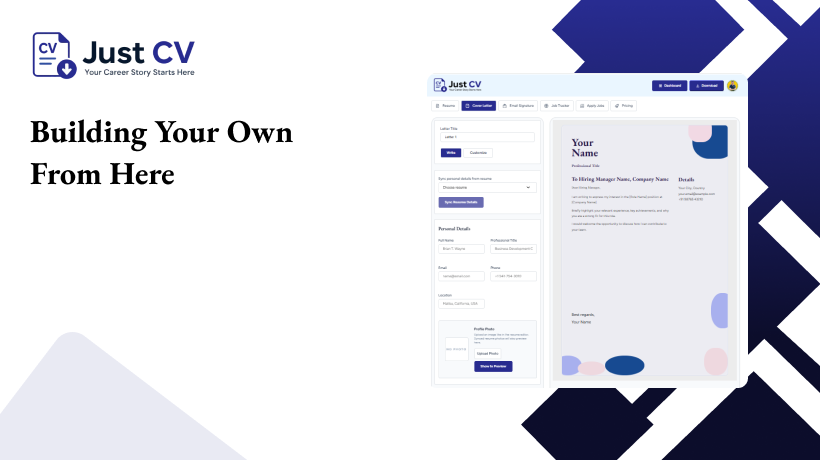
If you’d rather build a cover letter alongside your resume, matched formatting, saved drafts, no separate tool to manage, you can start with JustCV’s builder and adapt these same principles to your own experience.
Build My Resume
FAQs
Can I copy a cover letter example exactly?
It’s best not to. Hiring managers and applicant tracking systems increasingly see the same templated letters, and a copied example won’t reflect your actual experience. Use the structure and tone as a guide, but replace the specific details, the project, skill, or story, with your own.
How long should a cover letter be?
Most effective cover letters run 150 to 250 words, or about three to four short paragraphs. Shorter is generally better for online applications; a slightly longer letter can work for email introductions or referrals where more context is expected.
Do I need a different cover letter for every job?
Yes, at least in the details. The structure can stay similar, but the specific example or transferable skill you highlight should match that job’s posting, not stay generic across applications.
What’s the difference between a cover letter and a resume summary?
A resume summary is a brief, skimmable overview at the top of your resume. A cover letter is a separate, short letter that explains one specific connection between your background and the role, with more room for context and narrative.
Should I mention a career break in my cover letter?
If it’s relevant to explaining a gap in your timeline, a brief, factual sentence is enough, and no lengthy explanation is needed. Pairing it with what you did during that time, if anything, can add helpful context.
Do cover letters actually make a difference in hiring?
Data suggests they help. Jobscan’s analysis of real applications found cover letters were associated with meaningfully higher interview rates. Results vary by role and industry, but including one is rarely a disadvantage when it’s asked for or optional.
What should I avoid in a cover letter example?
Avoid restating your resume line by line, using vague claims without a specific example, and leaving in placeholder text from a template. Specificity is what separates a strong letter from a generic one.
Can AI help me write a cover letter?
AI tools can help draft a starting point or suggest phrasing based on your experience; you stay in control of the final content and details. Treat AI output as a first draft to edit, not a finished letter to send as-is.