Most applicant tracking systems can technically read a cover letter, but they don’t screen it as strictly as a resume. A short, plainly formatted cover letter saved as a standard PDF or DOCX, with no tables, columns, or graphics is safe for any ATS. You don’t need a separate “ATS strategy” for your cover letter the way you do for your resume.
If you’ve spent time getting your resume ATS-ready, it’s natural to wonder whether your cover letter needs the same treatment. The short version: a little, but far less than you’d think. Let’s walk through where the real risk is, and where it isn’t.
Key Takeaways
- ATS platforms can parse cover letters, but they weren’t built around them the way they were built around resumes.
- Resumes contain structured data (job titles, dates, skills). Cover letters are free-form narrative text, which is harder for any parser to score consistently.
- The formatting risks that break a resume tables, columns, images, headers/footers are the same ones to avoid in a cover letter, just less consequential if they slip through.
- Some applications mark the cover letter as optional. When that’s the case, a strong resume alone is a complete application -you’re not penalized for skipping it.
- The bigger opportunity in a cover letter isn’t ATS formatting – it’s using the job posting’s own language naturally, which helps both software and the human reading it afterward.
How ATS Handles Cover Letters vs. Resumes
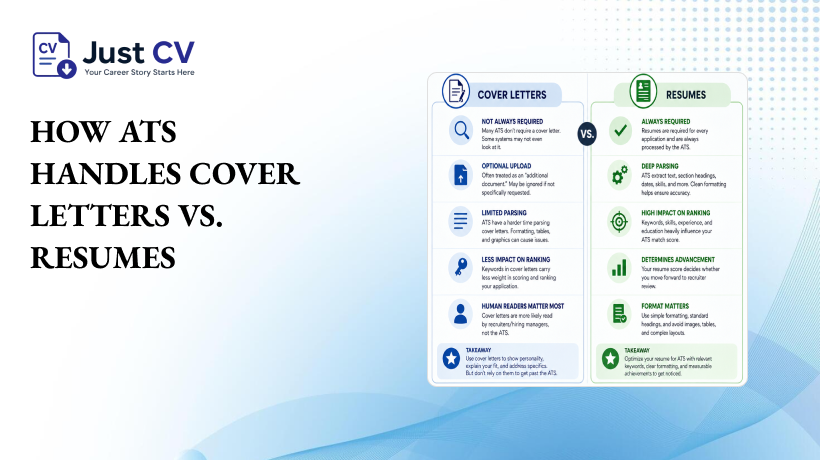
Applicant tracking systems were built to solve one problem first: pulling structured information out of a resume. That includes job titles, dates, employers, and skills. This lets recruiters search and rank candidates quickly. Cover letters came later. Most platforms still treat them as a secondary document.
That distinction matters more than any specific formatting rule. A resume’s structure headers like “Experience” and “Education,” bullet points, consistent date formats is exactly what a parser is designed to extract. A cover letter is closer to an essay: three or four paragraphs of ordinary sentences. Even a well-built parser has less to grab onto.
Two independent sources reach the same conclusion on this exact question. One explains that cover letters are commonly searchable by keyword inside an ATS, even when they aren’t formally parsed into structured fields the way resumes are. Another describes cover letters as “unstructured data.” That makes consistent, detailed extraction harder across different ATS platforms. It’s a genuinely honest, useful distinction one worth taking at face value rather than treating as a hidden risk.
Where a lot of general career advice stops short is here. It correctly says ATS reads cover letters less rigorously. Then it just tells you to format simply anyway, without saying what that actually changes for you as an applicant. It doesn’t, for example, tell you when a cover letter is even part of the process you’re being scored against. That’s the gap this article closes, and it’s covered directly below.
Cover Letter vs. Resume: ATS Handling at a Glance
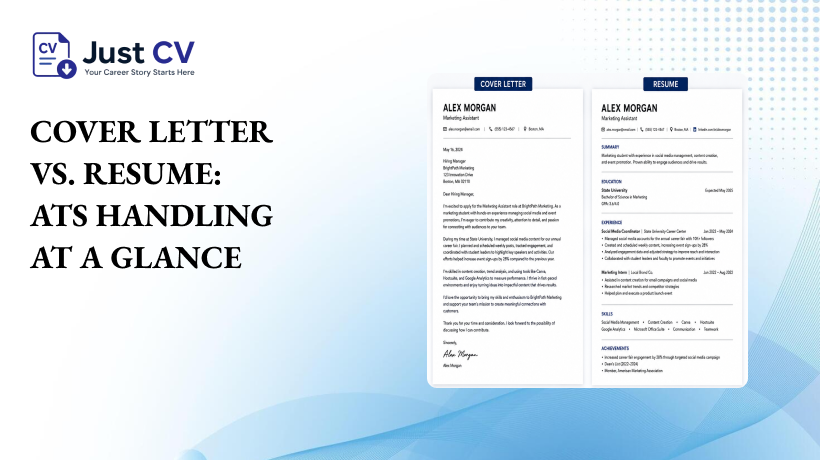
| Resume | Cover Letter | |
| Primary ATS function | Extract structured data (titles, dates, skills) | Often searchable by keyword; rarely fully “scored” |
| Format sensitivity | High – tables/columns can scramble parsing | Lower – plain paragraphs are naturally parser-friendly |
| Typical file handling | Always required, always parsed | Sometimes optional; parsing depth varies by platform |
| What actually helps | Standard section headers, reverse-chronological order | Job-posting language woven into real sentences |
| Formatting risk to avoid | Images, text boxes, multi-column layouts, headers/footers | Same list – lower stakes, but still worth avoiding |
What Still Matters
Even though the risk is lower, a handful of formatting basics keep your cover letter readable by both software and the person who eventually opens it. None of these require a redesign – they’re mostly about not doing a few specific things.
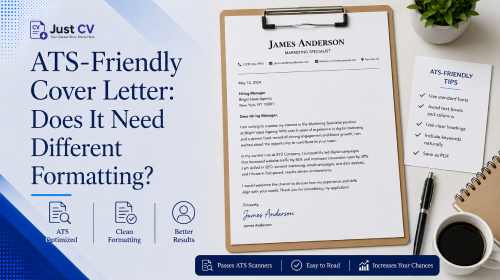
Cover letter ATS-format checklist:
- Save it as a standard file type. PDF or DOCX, unless the application specifically asks for something else.
- Use a single-column layout. No side-by-side text boxes or design columns , they can scramble reading order in some parsers.
- Skip images, icons, and logos. They add nothing a parser or recruiter needs, and some systems can’t read past them.
- Avoid headers and footers for key content. Some parsers skip these sections entirely, so don’t put your contact details or a key sentence there.
- Use standard fonts and structure. Ordinary paragraphs, no unusual symbols or decorative dividers.
- Mirror the job posting’s real language – naturally. If the role asks for “stakeholder management” and that’s genuinely part of your experience, use those words instead of a rough synonym.
- Keep it focused. A cover letter that stays on-topic and reasonably concise reads clearly to a parser and a human alike -there’s no fixed word count that guarantees anything, so let the content, not a formula, set the length.
That’s the complete list. There’s no separate “ATS cover letter format” to memorize beyond what you’d already do to write a clear, professional letter. For the resume side of this same discipline, see our cover letter format basics guide and how ATS resume screening actually works the same handful of rules apply to both documents.
When a Cover Letter Is Even Required

This is the question most cover-letter-and-ATS content skips entirely, and it’s the most practically useful thing to know.
- Required upload field: Some application flows mark the cover letter as mandatory before you can submit. In that case, include one a short, genuine letter is always better than a placeholder.
- Optional upload field: Many platforms label it “optional.” When that’s true, a complete, well-built resume is a full application on its own. Skipping an optional cover letter isn’t a mark against you.
- No field at all: Some applications don’t ask for one. There’s nothing to format for ATS purposes in that case the question doesn’t apply.
If you’re ever unsure whether a specific field is truly optional or just soft-worded, err toward including a brief, relevant letter. Not because the ATS demands it, but because a recruiter reading it later might. That’s a judgment call about the reader, not a formatting requirement from the software.
One more thing worth naming plainly: if you’re applying after a career break, a lateral move, or a stretch of freelance work, the cover letter- optional or not – is often where that context lands best. A resume lists what you did; a letter can explain why it counts. That counts, and it’s worth the extra few minutes when the field is there.
FAQs
Does ATS scan cover letters?
Many applicant tracking systems can read cover letters, but they generally parse them less rigorously than resumes. Cover letters are unstructured narrative text, so most systems extract less consistent detail from them than they do from a resume’s structured sections.
Do I need a plain-text cover letter for ATS?
You don’t need plain text specifically, but you should avoid tables, columns, images, and headers/footers. A standard PDF or DOCX with ordinary paragraphs is safe for virtually any ATS.
Is a cover letter required if the application marks it optional?
No. If a field is labeled optional, a strong, complete resume is a full application on its own. Including a short, relevant letter can still help once a recruiter reads it, but it isn’t required by the system.
Will keyword stuffing help my cover letter pass ATS?
No. Overusing keywords can hurt readability and may be flagged by some systems as low-quality writing. Using the job posting’s real language naturally, where it’s genuinely true of your experience, is more effective.
Should my resume and cover letter be formatted the same way?
It’s a reasonable default – simple, single-column layouts with no images or text boxes work safely for both. Your resume still needs more structural precision, since it’s the document ATS platforms are built to parse most closely. JustCV’s own templates follow this single-column, text-layer-preserving approach by default for exactly this reason.
Does the cover letter matter if my resume is already ATS-optimized?
Yes, but for a different reason than parsing. A well-formatted resume gets you through the software; a genuine, well-written cover letter is what a recruiter reads afterward to decide whether to reach out.
Formatting a cover letter for ATS doesn’t need to be its own project. Keep it simple, keep it honest about your experience, and save the real thinking for what you actually want to say. If you’re building both documents at once, JustCV’s ATS-tested templates keep the resume side straightforward too.