Returning to work after maternity leave means adding your time away to your resume clearly and honestly, without apology. You list it as a dated entry, briefly name what you did during it if relevant, and let your prior experience carry the weight. Employers see career breaks often – how you frame it matters more than the break itself.
Key Takeaways
- List maternity leave as its own dated entry – don’t try to hide or disguise it.
- You don’t owe an explanation beyond a short, factual line.
- “Rusty skills” are common and fixable, not a reason to undersell yourself.
- Talk about your return in terms of availability and readiness, not personal details.
- Return-to-work timelines shift for most parents – planning to return doesn’t always match exactly when it happens, and that’s normal.
Your Break Doesn’t Need an Apology
Somewhere along the way, resume advice turned career breaks into a confession. Your experience isn’t the problem. It’s an outdated resume approach that doesn’t reflect how careers actually work today.
Maternity leave is one of the most common reasons for a career break, and hiring managers who’ve been in the workforce for any length of time already know that. The people reading your resume have colleagues, friends, and often their own experience with exactly this kind of gap.
Timelines around returning to work also shift more than most people expect – and that’s worth knowing before you second-guess your own path. Research from Stanford and NYU found that many mothers expect to return to work sooner than they actually do, with the actual return often occurring later than planned, commonly around nine months postpartum (phys.org, Nov 2025). If your own return took longer than you first planned, that’s a well-documented pattern, not something unique to explain away.
The problem isn’t the gap. The problem is resume advice that treats every gap the same way – as something to minimize, bury in a footnote, or explain away. A maternity leave gap has its own shape: a return-to-work timeline, a specific kind of “getting back up to speed,” and often a need to talk about availability without oversharing. General career-break advice tends to flatten all of that into one generic script.
This guide is built specifically around maternity leave – the practical details of listing it, the honest conversation about rusty skills, and how to talk about your return. If you’re working through a different kind of career break – a layoff, a sabbatical, or caregiving for a family member – our Career Break on Your Resume post covers that broader ground in more depth.
Time away to raise a child is real experience with a real timeline. That counts, and it belongs on your resume the same way any other chapter of your career does.
How to Show Maternity Leave on Your Resume
There’s no single required format, but a few approaches work well and read as confident rather than defensive.
Checklist: Listing a maternity leave entry
- Use a dated entry, just like a job. Format: Family Leave / Maternity Leave – [Month Year]–[Month Year].
- Keep the description to one line. A short, factual note is enough (e.g., “Took leave to care for a new child”).
- Add relevant activity if it exists. Freelance work, volunteering, courses, or certifications during your leave can go in the same entry or as a separate line.
- Place it in chronological order. Don’t shift it out of sequence or disguise the dates – an unbroken timeline that doesn’t match reality raises more questions than an honest gap.
- Keep your job titles and achievements from before the leave intact. Your resume should still lead with what you accomplished in your last role.
- Skip generic euphemisms. “Personal time” or vague date ranges tend to raise more questions than a plain, factual “Maternity Leave” label does.
Worked Example (illustrative only)
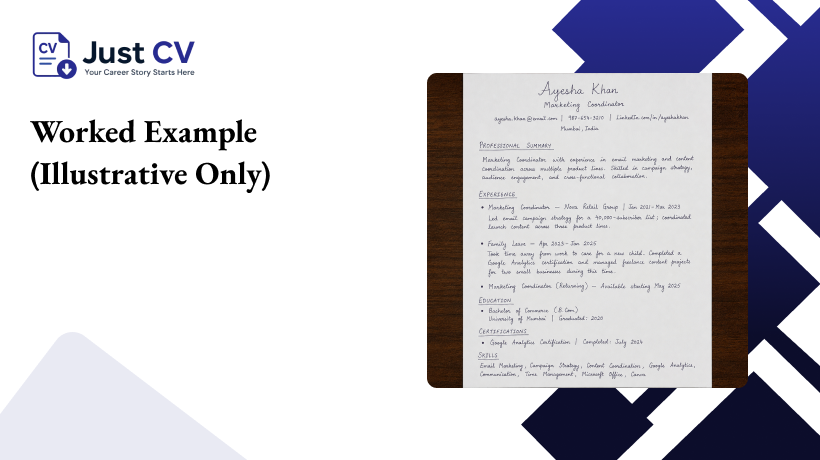
Marketing Coordinator – Nova Retail Group | Jan 2021–Mar 2023
Led email campaign strategy for a 40,000-subscriber list; coordinated launch content across three product lines.
Family Leave – Apr 2023–Jan 2025
Took time away from work to care for a new child. Completed a Google Analytics certification and managed freelance content projects for two small businesses during this time.
Marketing Coordinator (Returning) – Available starting [Month Year]
This structure keeps your professional identity front and center, names the leave plainly, and shows any relevant activity – without turning the entry into an essay.
If Your Skills Feel “Rusty”
Many people returning from maternity leave worry their skills have fallen behind. That worry is common, and it’s fixable, not disqualifying.
A skills gap after time away isn’t a personal shortfall. Most industries move fast enough that even people who never left the workforce spend real time catching up on new tools. The difference for someone returning from leave is that the catching-up happens more visibly, in one block, instead of spread across the year.
A few ways to address this honestly:
- Name specific tools you’ve kept current with, even informally – a course, a certification, or self-directed learning during leave.
- Lead with transferable strengths that didn’t go anywhere: project management, communication, problem-solving under time pressure.
- Frame any needed ramp-up plainly, if asked: “I’d want a quick refresh on [specific tool], and I’m already comfortable with the rest of the workflow.”
None of this requires overselling. Being specific is what reads as competent.
Talking About Your Return
Employers generally want to know two things: are you ready, and are you available on the terms the role requires. Everything beyond that is optional information you get to choose whether to share.
What’s useful to communicate:
- Your current availability (full-time, a phased return, flexible hours).
- Your readiness to start, including a date if you have one.
- Any changes to your work preferences (remote, hybrid, schedule) – stated plainly.
What you don’t need to share: childcare arrangements, health details, or anything else beyond the professional facts a hiring decision depends on. A short, confident line does more work than a long, personal explanation.
If a recruiter asks directly about the gap, a brief answer is enough: “I took maternity leave and I’m ready to return full-time starting [date].” You don’t need to fill the silence that follows.
Comparison: General Career-Break Advice vs. Maternity-Specific Guidance
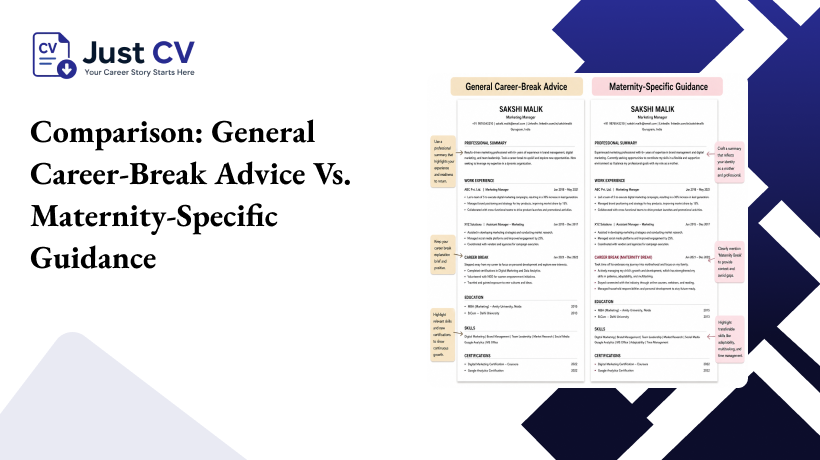
| Topic | Generic career-break advice | Maternity-specific approach (this guide) |
|---|---|---|
| How to list the gap | One-size-fits-all “explain the gap” template | Dated entry format specific to family leave, with optional activity line |
| Skills concerns | Vague “brush up on skills” advice | Names ramp-up as normal, gives specific framing language |
| Talking about return | Generic “be confident” advice | Concrete script for availability, readiness, and boundaries on personal disclosure |
| Depth on this scenario | Broad – covers layoffs, sabbaticals, and leave together | Narrow and specific – built only around the return-to-work-after-maternity scenario |
This is also why this guide exists as its own piece. Our broader Career Break on Your Resume post intentionally stays general – it’s built to serve anyone returning from any kind of break. This guide fills in the maternity-specific detail a general post can’t cover without losing focus for other readers.
Building This Into Your Resume
You don’t have to figure out the exact wording alone. JustCV’s resume builder helps you structure a maternity leave entry using the format above, suggests phrasing for the “rusty skills” and return-to-work sections, and keeps your prior job titles and achievements front and center – AI assists with drafting, you stay in control of every line.
If you’re also weighing how to frame a broader career shift alongside your return, our Resume for a Career Transition post covers how to make prior experience count in a new direction.
Your career story doesn’t pause because you took time to raise a child – it continues, with this chapter written in plainly, right where it belongs.
Start Free and build a resume that lists your leave honestly, showcases what came before it, and gets you back to the work you’re ready for.
FAQs
How do I list maternity leave on my resume?
List it as a dated entry, similar to a job: “Family Leave” or “Maternity Leave” with the start and end month/year. Add one short, factual line about the leave, and include any relevant activity like courses or freelance work if applicable. Keep your prior job titles and achievements intact above it.
Will employers penalize me for a maternity leave gap?
Maternity leave is a common, well-understood reason for a career break, and many hiring managers have direct or indirect experience with it. A clearly listed, honestly framed gap is far less likely to raise concern than a hidden or vague one. How you present your return matters more than the gap itself.
Should I explain why I took maternity leave on my resume?
A brief, factual line is enough – for example, “Took leave to care for a new child.” You don’t need to justify or elaborate further. Save any additional context, if you choose to share it, for an interview conversation rather than the resume itself.
What if my skills feel outdated after maternity leave?
A skills refresh after time away is normal and doesn’t reflect on your ability. Name any tools or courses you’ve kept current with, lead with transferable strengths that didn’t lapse, and be specific if asked about ramp-up needs – specificity reads as competence, not a gap in ability.
How do I talk about availability when returning from maternity leave?
State your availability plainly – full-time, phased, or with a specific start date – either on your resume or early in the interview process. You don’t need to explain childcare arrangements or personal circumstances; a clear, factual statement of readiness is sufficient.
Should I use a functional resume format to hide my maternity leave gap?
It’s generally better to keep a clear, chronological format with the leave listed openly rather than restructuring your resume to obscure it. Hiding a gap through format tricks tends to draw more attention and questions than a plainly labeled entry does.
How is this different from general career break resume advice?
General career-break advice covers many situations at once – layoffs, sabbaticals, caregiving – and stays broad by design. This guide focuses specifically on maternity leave: how to list it, address skill concerns, and talk about your return, with detail a general guide can’t include.