A career change resume is most effective when it highlights transferable skills first. Not job titles.
Don’t make a recruiter guess how your old role applies. Show them directly. Map your real skills like problem-solving, leadership, client management onto the language of your new field. That one shift is often the difference between a resume that gets skimmed past and one that gets read.
Key takeaways
- Start with your transferable skills, not your previous job title.
- Use a skills-mapping table to translate old-industry language into new-industry language
- Quantify achievements in outcomes, not just tasks outcomes travel across industries better than tools do
- One well-built summary statement can do more work than a full rewrite of your work history
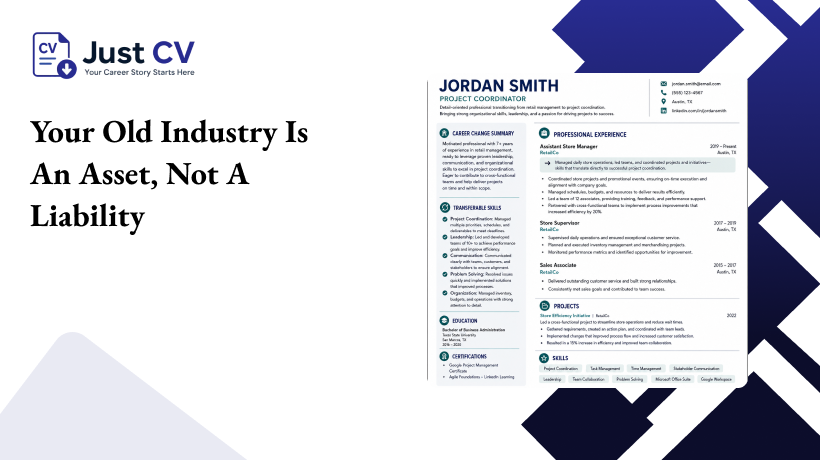
Your Old Industry Is an Asset, Not a Liability
Most career-change advice starts from a defensive place. It assumes you need to explain away your background. That framing isn’t just discouraging. It’s backwards.
The real issue isn’t your experience. It’s translation.
A resume written in one industry’s language is hard for a hiring manager in another industry to read fast. That’s a formatting problem. It’s not proof that your experience doesn’t count.
General “career change resume” guides mostly cover formatting: layouts, summary length. Few address the translation gap directly. Most treat your old industry as noise to minimize, not as your strongest material.
Here’s the reframe. A teacher moving into corporate training isn’t starting over- they’re already fluent in curriculum design and stakeholder communication. A retail manager moving into operations isn’t starting from scratch, they already manage teams, inventory, and budgets in a fast-paced environment.
Leading a team. Solving a recurring problem. Managing a project with limited resources. None of that depends on which industry it happened in and it all counts.
Your job now isn’t to prove your experience is valid. It’s to show, clearly, where it already overlaps with what your next role needs.
How to Map Transferable Skills
A transferable-skills map does one job. It turns “my experience should count” into something a hiring manager can verify in ten seconds.
Build this map before you touch your resume draft.
How to build your skills map — checklist
- Pull 3–5 real job postings for your target role and highlight repeated requirements
- List the key responsibilities you handled in your last 2–3 roles, focusing on what you did rather than your job titles.
- Match each requirement to a specific action from your history, using the target industry’s terminology
- Drop any match that feels forced- a thin connection undermines the strong ones
- Rewrite each match as a one-line, outcome-focused resume bullet
Here’s how this works in practice:
| Old-industry skill | What you actually did | New-industry translation |
|---|---|---|
| Classroom management (Education) | Planned lessons and kept 30+ students on task with limited resources | Program coordination under constrained resources |
| Retail team leadership | Scheduled and coached a 12-person team, managed shrinkage and stock | People management and operational oversight |
| Client account handling (Sales) | Managed renewals and expansion conversations for 40+ accounts | Relationship management and revenue retention |
| Volunteer event coordination | Organized logistics and vendors for a 200-person fundraiser | Cross-functional project management |
| Freelance client work | Delivered projects independently against deadlines and budgets | Self-directed delivery and stakeholder management |
Look at what stays the same in every row: the action and the outcome. Only the label around them changes.
This is the exact work most career-change guides skip. They tell you transferable skills exist. They rarely show you how to translate one industry’s language into another’s, line by line.
A Worked Example
Here’s a hypothetical career changer. Five years of experience in teaching high school students. Now moving into corporate learning and development (L&D).
Before (industry-locked): “Taught high school science to classes of 30+ students. Graded assignments and managed classroom behavior. Communicated with parents about student progress.”
This is accurate. But it reads as unrelated to L&D, unless the recruiter already knows how to translate it themselves.
After (transferable-skills framing): “Designed and delivered structured learning programs for 30+ learners per cohort, adapting content to different skill levels. Built assessment tools to track comprehension and iterated content based on results Maintained regular communication with stakeholders on progress and outcomes.”
Same five years. Same real experience.
The second version just uses words an L&D hiring manager already scans for: learning programs, cohort, assessment tools, stakeholder communication.
Nothing here is invented. You’re describing the same experience using the language of the role you want, not the origin.This is what a resume for a career transition should do: not hide where you came from, but make the overlap impossible to miss.
Putting It Together in Your Summary
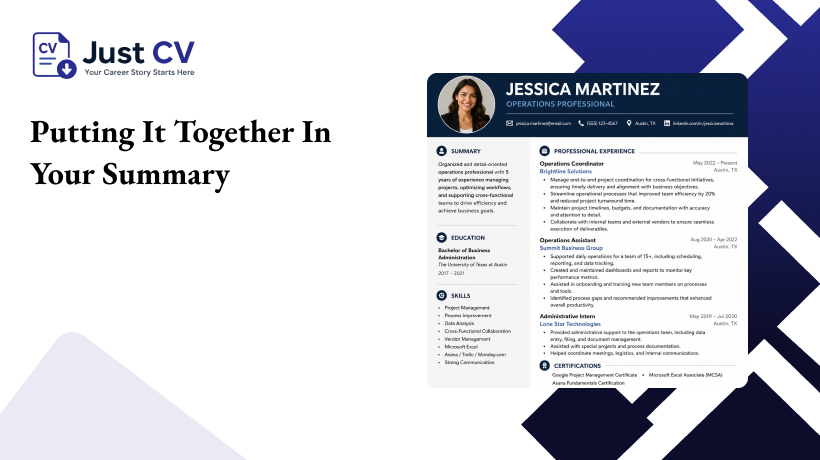
Your resume summary is the quickest place to reframe your experience for your target role.
A short, transferable-skills-first summary at the top often does more work than rewriting your entire work history.
Simple summary formula
- Lead with your strongest transferable skill area
- Name one or two quantified outcomes
- Clearly state your target role without apologizing for your career change.
Build your resume summary using this format: “[Transferable skill] professional with [X years] of experience managing [specific responsibility].”
Format matters here too. A clean, chronological, single-column resume is generally easier for ATS to parse than complex, multi-column layouts. Pair that simple structure with your transferable-skills-first summary rather than switching to a fully functional (skills-only) resume.
Frequently Asked Questions
How do I write a resume for a completely different industry?
Start by mapping your past actions not job titles to the requirements in your target field’s job postings. Translate the language, keep the outcomes, and lead your summary with the overlap. A chronological format with a transferable-skills-first summary usually works better than starting from scratch.
Should I use a functional (skills-based) resume for a career change?
Not necessarily. A chronological, single-column resume is generally easier for ATS to parse than complex or multi-column layouts. A stronger approach is often a chronological resume with a transferable-skills summary at the top, rather than a full functional rebuild.
What if I don’t have any experience directly related to my new field?
Look for the underlying skill, not a literal title match. Project coordination, client communication, and problem-solving under constraints all transfer across industries, even without a matching job title.
How long should a career transition resume be?
One page is usually enough for most career changers, especially with under 10 years of experience. Focus on the roles and achievements most relevant to your target field rather than including everything.
Do I need to explain my career change in my resume?
Not extensively. A one-line summary framing your direction is usually enough. Save the fuller story your motivation and goals for your cover letter or interview.
Is it bad to have unrelated jobs on my resume?
No. Every role can be described in terms of what you actually did and achieved. That’s what a resume for a career transition is for.